Sunday, 10 July 2022

Trondheim. Kristiansund and Alesund (30th June - 5th July)

Trondheim is Norway's third largest city and was founded in 997 AD. The gothic Nidaros Cathedral is quite impressive. We had nice warm weather ( for a change) so spent a few days walking around the city


We then took the coastal route to Kristiansand. The city is the most densely populated place in Norway spread across 4 islands.


We decided to take the Atlantic route next, a unique stretch of road which takes you right out to the ocean's edge. In 2005, the road was voted Norway's 'Engineering Feat of the Century' and  according to Wikipedia is also known to be the world's most beautiful drive.
The road was opened in 1989 and has National Tourist Route status.
It connects a number of islands with the mainland via a total of eight bridges over 8kms, the most prominent being Storseisundet Bridge

(Arial photo courtesy of visit Norway.com)


Next stop, Ålesund
Ålesund is a port town on the west coast of Norway, at the entrance to the Geirangerfjord. It’s known for the art nouveau architectural style in which most of the town was rebuilt after a fire in 1904.


Next, the scenic drive to Trollstigen

Wednesday, 6 July 2022

Earth's most beautiful road trip?

From Tromsø, we took the coastal route (300 kms) towards the Lofotens. We stayed overnight in Harstad at the start of the Lofoten archipelago, and this was the view from our camper

and the following morning, this was the beautiful scene that greeted us.

Looking more closely at the map, we saw that there was only one road in and out of the islands and as and we'd seen them from the Hurtigruten many years ago, we decided not to go any further.

About a month ago, Mark found an article on the BBC by Anthony Ham called "Is this the Earth's most beautiful road trip?" the Kystriksveien – a route also known as the Coastal Way or Fv17. As we were already in the Arctic, we followed this route south instead. 
We drove from Harstad to Lodingen and boarded the first ferry of many, this one to Bognes. 
Then lots more stunning scenery as seen through the car window


Our next stop was Saltstrauman, renowned for the strongest maelstrom in the world.
The phenomenon is governed by the rise and fall of the currents and very 6 hours almost 400 million cubic meters of water have to pass through a 3 km long and 150-meter wide strait. The water can move at speeds of up to 20 knots or about 10 meters per second. It was quite something to watch, especially the fishing boats moving backwards around one of the whirlpools 


It was also the second and final chance to see the midnight sun but one of their mountains got in the way .


These photos were taken at 00.45 am

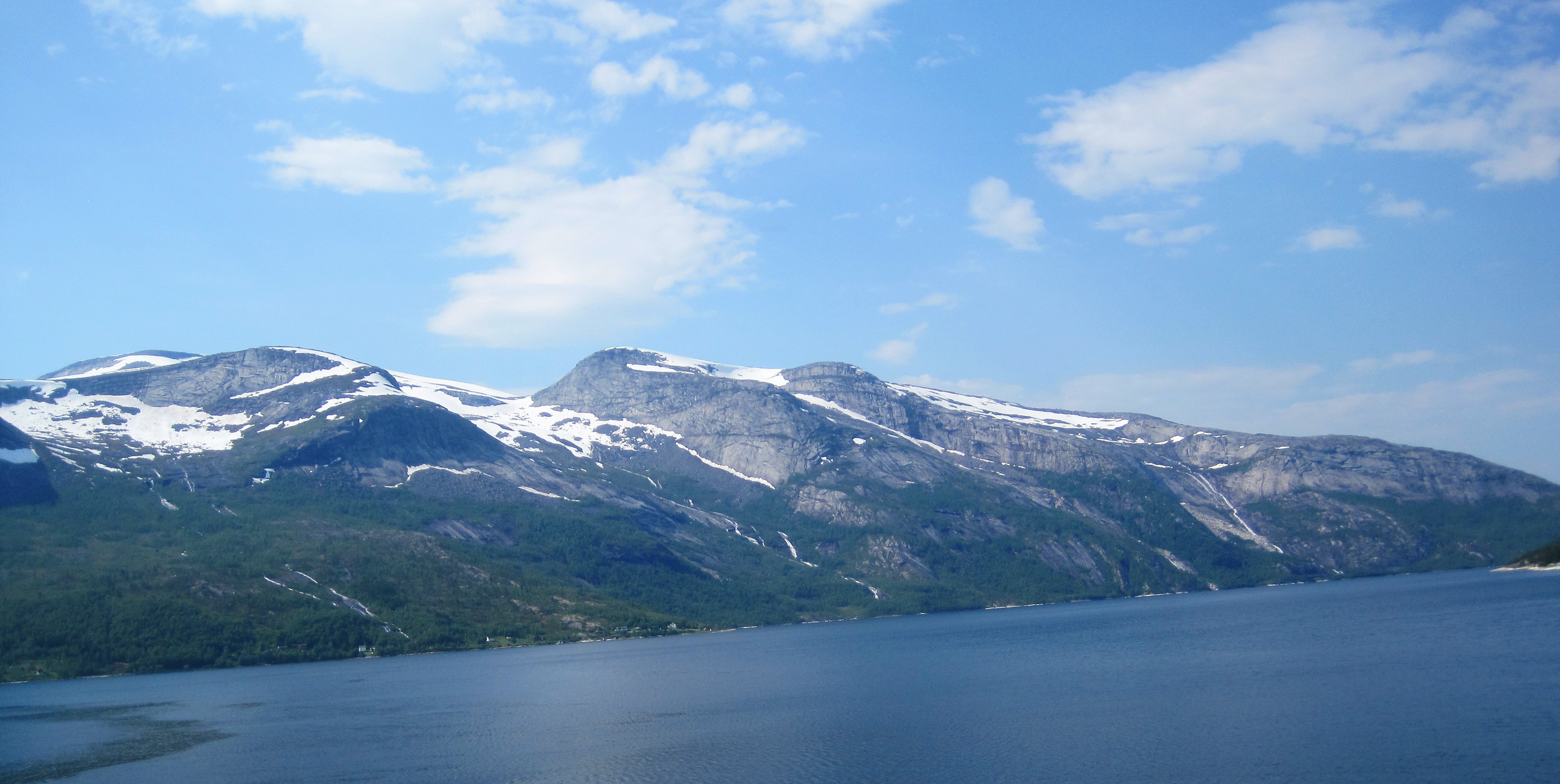
Later that day we followed the FV17 and the scenery was fantastic with majestic snow topped mountains and streams cascading down as the snow melted. 


The second ferry that day from Jektvik to Kilboghamn crossed the Arctic circle 


That night we stopped at a free rest stop by the side of a fjord


The next morning it was up into the  clouds on the high ground. More bridges  and another 4 ferries before we camped for the night at another farm in the hamlet of Flått where river joins fjord.


The route is 650kms long and we finished the drive on June 30th.

In the article, historian Mette Larsen comments 
"In Norway, if there is an obstacle, like a mountain or a body of water, we build a road over it or around it, a bridge across it or a tunnel under it. We have the longest road tunnels in the world. We build roads in places that others think are impossible. And where we can't build a tunnel, we send a ferry."

So far we've been on 8 ferries, some only 15 minutes long and I've lost count of how many bridges and tunnels we have gone over or driven through. I suspect there will be many more before we end our tour of Norway.

Saturday, 2 July 2022

To Norway and the midnight sun

We crossed northern Sweden into the Arctic circle and spent the night in a muddy field north of Narvik on the Norwegian coast. The next day we took one of the scenic back roads around our first fjord (in the Ford) and stayed the night on a farm in Sørreisa. The owner left a big bag of wood for us to make a fire to keep warm. There was still snow on the mountains and that night it went down to 7C, and this is supposed to be SUMMER!

The next day we carried on northward to Tromsø, the third largest city in the Arctic, but given that the other two are Russian military bases, they don't count. It was the base for most of Amundsen's Arctic expeditions. We arrived in time for the solstice and it was cloudy, but we stayed up like a couple of geeks anyway. We booked to stay for 6 days as we had read that midsummer was now celebrated on 24th June to coincide with the feast of John the Baptist, but it turns out that northern Norway doesn't celebrate it any more. It was nice to have a base for a few days and we visited both of the polar museums. I took the cable car to the lookout point and Mark decided to stretch his legs and climbed up the 1,203 steps, then back down again. The view was amazing 


We finally got to see the midnight sun through a gap in the clouds on the last night. We waited to see it rise again 


We found the following stats on timeanddate.com: 

Current Time: 26 Jun 2022, 00:44:45
Sun Direction: 359.49° N↑
Sun Altitude: 3.24°

And 6 minutes later:

 (

Current Time:26 Jun 2022, 00:50:02
Sun Direction:0.71° N↑
Sun Altitude:3.24°


The following day we left the city and started our journey south.